Review
Fixed Income
The yield on the 10-year US Treasury reached its provisional year-to-date high of 4.67% on 18 May. On the same day, Kevin Warsh assumed the chairmanship of the Federal Reserve, reaffirming the Fed’s independence and its determination to bring inflation under control. By the end of June, the 10-year yield had declined to 4.42%, compared with 4.32% at the end of March and 4.18% at the end of 2025.
The yield on the two-year US Treasury – widely regarded as a barometer of policy rate expectations – rose over the same period from 3.80% to 4.14% (end-2025: 3.47%). The Federal Reserve kept its policy rate unchanged within the target range of 3.50% to 3.75% at both its final meeting under Jay Powell on 29 April and its first meeting under Kevin Warsh on 17 June. The next policy decisions are scheduled for 29 July and 16 September. Markets currently expect the Fed to remain on hold.
In the euro area, yields on 10-year German Bunds also moved higher initially. Having stood at 3.00% at the end of March, they reached a year-to-date high of 3.19% on 18 May before retreating to 2.88% by the end of June (end-2025: 2.86%). During the quarter, the European Central Bank began tightening monetary policy, raising its policy rates by 25 basis points on 11 June. Its next policy meetings are scheduled for 23 July and 10 September. Some market participants already expect a further rate increase in July.
Following Prime Minister Keir Starmer’s resignation announcement on 22 June, the UK is once again preparing for a change of government — its seventh in just ten years. Political instability has therefore remained a defining feature of the country since the Brexit referendum. Yields on 10-year UK government bonds (Gilts) rose to 5.20% in mid-May before declining to 4.77% by the end of June (end-March: 4.83%). The Bank of England has kept its policy rate unchanged at 3.75% so far this year. Its next monetary policy meetings are scheduled for 30 July and 17 September.
In Japan, yields on 10-year government bonds rose from 2.30% at the end of March to a temporary high of 2.80% in mid-May before ending the quarter at 2.70%. Long-term interest rates thus reached their highest level in more than three decades. During the quarter, the Bank of Japan raised its policy rate to 1.00% — also its highest level since 1995. Its next policy meetings are scheduled for 31 July and 18 September.
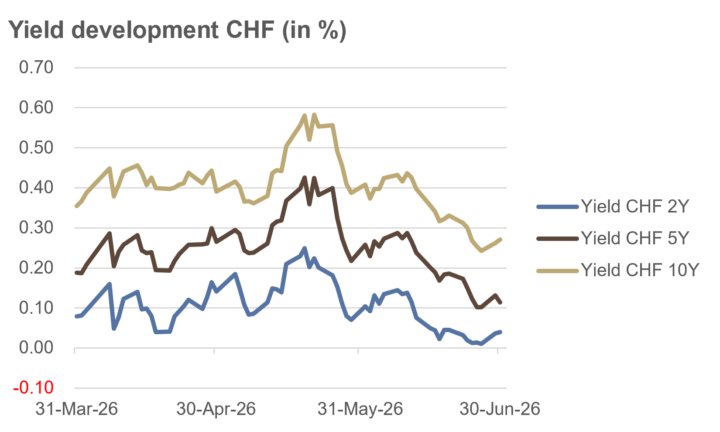
Yields on 10-year Swiss government bonds broadly followed the global trend. After reaching an interim high of 0.58% in mid-May, they declined to 0.27% by the end of June (end-March: 0.36%). The Swiss National Bank’s next monetary policy assessments are scheduled for 24 September and 10 December. The policy rate currently stands at 0.00%, and markets do not expect any changes before year-end. The first economists do not anticipate a rate increase to 0.25% until the course of 2027.
Source: own illustration
Credit
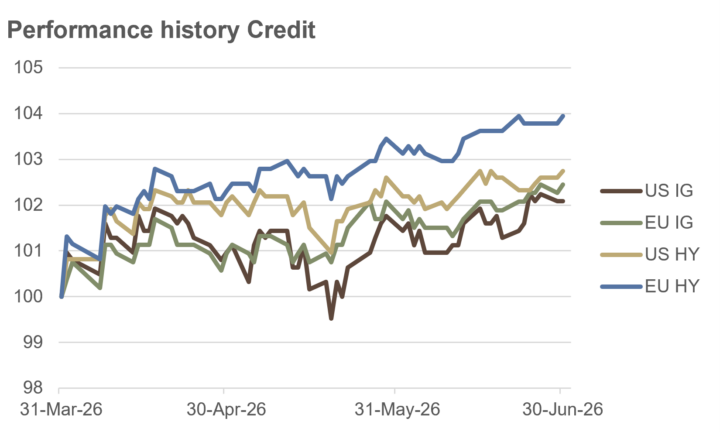
Corporate bonds delivered a strong performance during the second quarter. European bonds outperformed their US counterparts, supported by the modest decline in interest rates across the euro area. European high-yield bonds gained 3.9%, followed by US high-yield bonds with a return of 2.7%. Investment-grade bonds also performed well on both sides of the Atlantic, posting gains of more than 2%.
Price performance reflected the sharp rise in government bond yields through mid-May. As long-term yields subsequently declined, corporate bonds staged a corresponding recovery.
At the same time, credit spreads on high-yield bonds narrowed markedly on both sides of the Atlantic. In the US, high-yield spreads tightened from 3.46% at the end of March to 2.75% by the end of June, while in Europe they narrowed from 3.33% to 2.70%. This underlined the significant improvement in investor risk appetite over the course of the quarter.
The more constructive market environment was also evident across other segments of the credit market. Global convertible bonds advanced 14.9% during the second quarter, lifting their year-to-date return to 18.3%. Emerging market bonds denominated in US dollars gained 4.7%, more than offsetting the losses recorded in the first quarter.
Source: own illustration
Equities
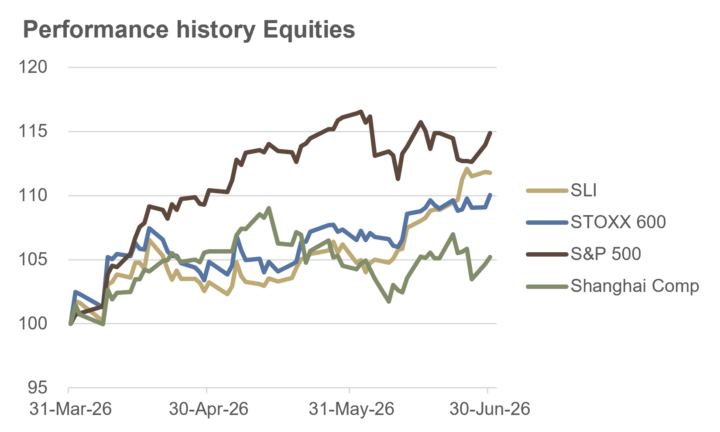
Global equity markets delivered a very strong performance during the second quarter. In the US, the benchmark S&P 500 reached a new all-time high of 7,610 on 2 June. By the end of June, this translated into a quarterly gain of 14.9% and a year-to-date return of 9.6%. The technology-heavy Nasdaq Composite advanced by more than 21% during the quarter and was up 12.8% year to date at the end of June. The small-cap Russell 2000 was particularly strong, gaining more than 20% year to date. At the same time, stock selection within the technology sector became increasingly important. For the so-called ‘Magnificent Seven‘, June was one of the weakest months in their stock market history, with the exception of Nvidia. Following massive investment in artificial intelligence, investors are increasingly demanding evidence that these multi-billion-dollar expenditures will translate into corresponding earnings growth.
European equity markets also performed well. The pan-European STOXX Europe 600 gained 10.0% during the second quarter and was up 8.3% year to date. At the individual stock level, ASML stood out with a share price gain of 78% since the beginning of the year, while SAP declined by 33%.
Switzerland’s Swiss Leader Index (SLI) advanced 11.8% during the second quarter and posted a year-to-date gain of 6.1%. Within the Swiss market, VAT Group (+84%) and ABB (+48%) ranked among the strongest performers, while Partners Group (-31%) came under pressure as investors grew increasingly cautious towards private market investments.
Equity market performance across Asia was mixed. While the Shanghai Composite gained 5.2% during the second quarter, the Hang Seng declined by 7.7%. Japan’s Nikkei 225 was a notable outperformer, rising 37% during the quarter and more than 39% year to date.
The strongest performance among the major equity markets this year came from South Korea’s KOSPI, which surged by around 100%, driven by continued enthusiasm for semiconductor manufacturers Samsung Electronics and SK Hynix. Taiwan’s TAIEX also benefited from strong global demand for AI- and semiconductor-related stocks, gaining 59% year to date. By contrast, Indonesia’s Jakarta Composite Index was the weakest performer, ending the first half of the year down 34%.
Source: own illustration
Commodities and Alternative Investments
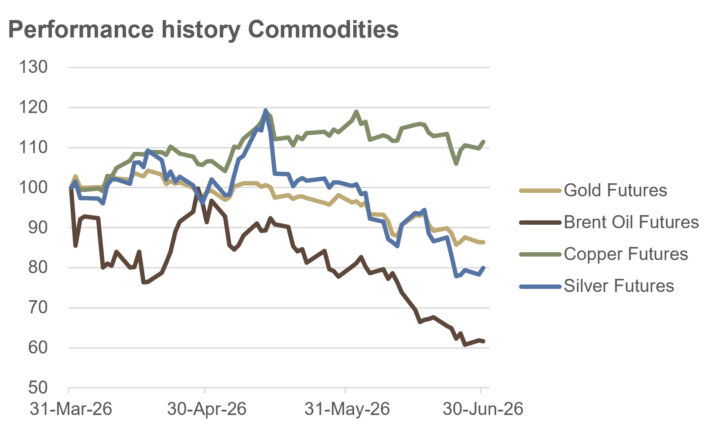
The price of Brent crude oil declined sharply during the second quarter, falling by almost 40% from the end of March, from above USD 118 to USD 73 per barrel. Despite this sharp correction, it remained up by around 20% year to date. Price movements were driven primarily by the conflict between the US and Iran, as well as uncertainty surrounding shipping through the Strait of Hormuz.
Copper prices rose by 11% during the second quarter and were up 9.5% year to date. This suggested that markets were seeing a diminishing drag from weakness in China’s property sector, alongside more resilient demand for industrial metals.
By contrast, precious metals performed significantly weaker. Gold fell by 14% during the second quarter, while silver declined by 20%. As a result, gold was down 7% year to date and silver 16%. Expectations of tighter global monetary policy, technical profit-taking and reports of increased liquidity needs among certain central banks in the Middle East were cited as the main factors weighing on prices.
Cryptocurrencies also ranked among the weakest-performing asset classes during the first half of the year. Bitcoin fell by 33% against the US dollar, while Ethereum declined by 47%. By the end of June, Bitcoin had fallen back below the USD 60,000 mark.
Source: own illustration
Currencies
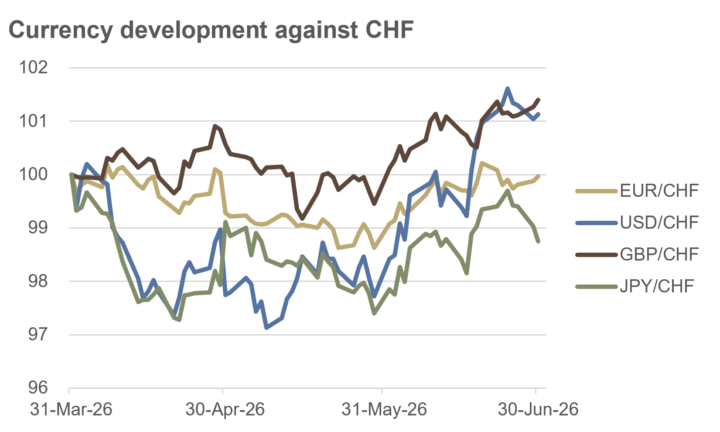
Movements in the foreign exchange market remained broadly moderate during the second quarter, although several currency pairs recorded notable developments. Most strikingly, USD/JPY climbed above JPY 162, its highest level in around four decades. Since the Japanese Prime Minister took office in early October 2025, the US dollar has appreciated by almost 10% against the yen and by 3.8% since the beginning of the year.
EUR/CHF ended the second quarter virtually unchanged at CHF 0.923, broadly in line with its level at the end of March. At the beginning of the year, the euro had traded at CHF 0.931.
The US dollar continued to strengthen against the Swiss franc. USD/CHF rose to CHF 0.808 by the end of June, up from CHF 0.799 at the end of March and CHF 0.793 at the end of 2025. Despite the political uncertainty in the UK, sterling also appreciated against the Swiss franc. GBP/CHF gained 1.4% during the quarter to CHF 1.072. By contrast, the Japanese yen weakened by 1.3% against the Swiss franc during the second quarter and by 1.7% year to date.
The US Dollar Index (DXY) rose by 1.3% during the second quarter and was up 2.9% year to date, extending the US dollar’s relative strength against the major developed market currencies.
Alongside the US dollar, the Australian dollar was among the strongest-performing currencies during the first half of the year. It appreciated by 3.9% against the US dollar and by 6.4% against the Swiss franc year to date. By contrast, the euro weakened by 6.3% against the Australian dollar.
Source: own illustration
Outlook
Many of the risks are well known: further geopolitical shocks, persistently elevated inflation, rising tensions in the private credit market and the upcoming US midterm elections. While these risks provide ample scope for negative narratives, they appear to be largely reflected in current market prices.
Growth expectations for the US have weakened noticeably in recent weeks. As of 1 July, the Atlanta Fed’s GDPNow model estimates annualised second-quarter growth at just 1.2%, down from more than 3% only a few weeks ago. First-quarter growth came in at an annualised 2.1%. At the same time, the probability of a US recession this year, as implied by the prediction market Kalshi, has fallen from almost 40% at the end of March to just 7.5% (as of 4 July 2026).
Inflationary pressures, by contrast, have picked up temporarily. US headline inflation rose to 4.2% in May, while core inflation reached 2.9%. According to the Cleveland Fed’s Inflation Nowcasting model, however, headline inflation is expected to ease to 3.9% in June and to 3.5% in July (as of 3 July 2026).
In the euro area, gross domestic product contracted by 0.2% in the first quarter, or around 0.8% on an annualised basis, after modest growth had initially been expected. It marked the first quarterly contraction since the end of 2022, driven primarily by the sharp downturn in Ireland and energy-related disruptions stemming from the conflict in the Middle East. Most economists expect a moderate recovery in the second quarter, with growth of around 0.25%, equivalent to roughly 1% on an annualised basis. At the same time, inflation appears to have already passed its temporary peak. After reaching 3.2% in May, the preliminary estimate for June eased to 2.8%.
Against this backdrop, markets began pricing in a synchronised global cycle of policy rate increases. The European Central Bank (ECB) and the Bank of Japan each raised policy rates by 25 basis points in June. Earlier, the Reserve Bank of Australia had tightened monetary policy by the same amount. The Reserve Bank of New Zealand is expected to be the next major central bank to raise rates in July. By contrast, no further policy moves are expected from the other major central banks during the summer months.
Markets currently price in one, and at most two, rate hikes from the Federal Reserve before year-end, following the summer break. We do not share this view. Instead, we expect the Fed to wait for the findings of the newly established task forces and to leave monetary policy unchanged for the time being. The new Fed Chair, Kevin Warsh, has also announced that the Fed intends to discontinue forward guidance. At the same time, the central bank is likely to place greater emphasis on the supply side of the economy and on productivity gains driven by new technologies. Should this approach become established, strong economic growth may no longer automatically be interpreted as inflationary.
For the third quarter, we expect a Goldilocks scenario characterised by solid economic growth and further easing inflation, particularly if the Fed’s new monetary policy framework gains traction. In our view, the two key market drivers will remain developments surrounding artificial intelligence and the security of shipping through the Strait of Hormuz. While the second year of the US presidential cycle has historically been particularly volatile, and newly appointed Fed Chairs have often faced an early test from financial markets, we would continue to view any equity market setbacks as buying opportunities rather than the beginning of a new bear market. Particular attention will remain focused on credit and fixed income markets, where developments in bond spreads are likely to provide an early indication of any meaningful shift in the macroeconomic environment.
Fixed Income
Following the recent repricing of interest rate expectations, the scope for a further significant rise in long-term government bond yields appears limited. Declining inflation and a Federal Reserve that is likely to remain on hold for the time being point to a more stable overall environment. At the same time, government bonds continue to play an important role as portfolio diversifiers, particularly if geopolitical risks or concerns about economic growth were to intensify temporarily.
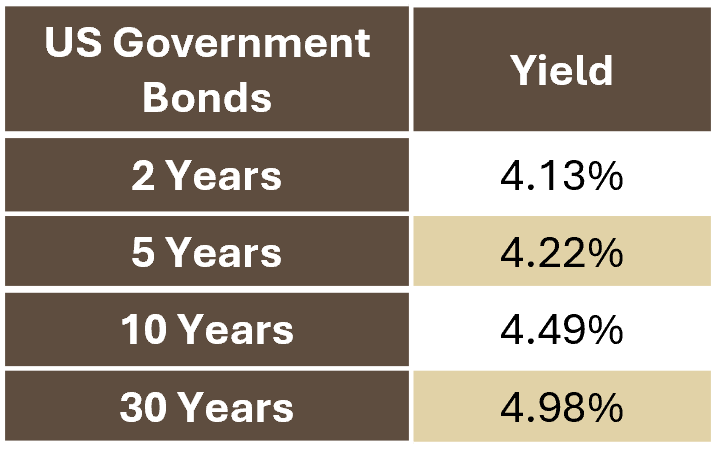
We are currently paying close attention to the shape of the US Treasury yield curve. Should the yield on 10-year Treasuries fall back below that of two-year notes, this would represent a classic signal of a marked economic slowdown. Likewise, we would interpret a sustained widening of the spread between 30-year and five-year Treasury yields to well above 150 basis points as an indication of waning confidence in US fiscal policy and the country’s long-term debt sustainability. At present, however, we see no evidence of such a scenario.
Source: own illustration; as of 2 July 2026
We continue to regard a strategic allocation to inflation-linked government bonds as appropriate. Geopolitical tensions, an increasingly fragmented global economy and the risk of renewed energy price shocks all argue in favour of maintaining protection against unexpected inflation surprises, even in an environment of moderating inflation.
Credit
The fundamental backdrop for corporate bonds remains broadly constructive. Solid economic growth, resilient corporate earnings and still-low default rates continue to support both investment-grade (IG) and high-yield bonds. At the same time, credit spreads have narrowed significantly across many market segments, suggesting that future returns are likely to be driven increasingly by carry rather than by further spread compression.
We continue to monitor the private credit market closely. Should tensions intensify further, a widening of credit spreads would likely rank among the earliest warning signs of a broader economic slowdown.
Against this backdrop, we continue to favour investment-grade bonds over high-yield bonds and remain highly selective within the private credit market.
Equities
The fundamental backdrop remains supportive of equities. Expected declines in inflation, resilient corporate earnings and a less restrictive monetary policy stance by the Federal Reserve provide a favourable foundation for risk assets. At the same time, following the extraordinary market rally of recent years, current valuations increasingly require earnings growth to keep pace. It is therefore no coincidence that talk of a potential “earnings bubble” has become more widespread – the view that today’s elevated corporate profits may prove unsustainable over the longer term and partly reflect the counterpart of high government deficits and low household savings rates.
We consider these concerns premature. In our view, the structural growth drivers remain firmly in place. Investment in artificial intelligence, automation and digitalisation should continue to support productivity and, in turn, corporate earnings. We would therefore continue to view temporary market corrections as tactical buying opportunities rather than the beginning of a prolonged bear market.
Within equity portfolios, however, a modest overweight in defensive sectors such as healthcare, utilities and consumer staples appears appropriate. These sectors have historically been less sensitive to the economic cycle and can help stabilise portfolios during periods of heightened market volatility.
Commodities and Alternative Investments
Gold remains strategically attractive despite the prospect of lower inflation. Continued strong demand from central banks, geopolitical uncertainty and elevated levels of global government debt continue to support a structurally robust demand outlook. Silver should also benefit from its dual role as both a precious and an industrial metal and may offer further catch-up potential relative to gold. Investors should bear in mind, however, that silver has historically exhibited significantly greater price volatility than gold.
For oil, shipping through the Strait of Hormuz remains the key geopolitical risk factor. Supply disruptions could trigger temporary price spikes at any time. However, one factor argues against persistently higher oil prices: time. The current futures curve does not point to prolonged supply shortages and therefore does not suggest a sustained move to higher price levels.
The outlook for industrial metals remains constructive. A stabilising global economy together with continued investment in electrification, data centres and infrastructure should continue to support robust demand for copper in particular.
Currencies
We expect the US dollar to remain broadly stable to slightly weaker against the Swiss franc over the remainder of the year. Should the Federal Reserve indeed embark on a prolonged pause while global risk appetite remains firm, the US dollar is likely to surrender part of its current interest rate advantage. During periods of heightened uncertainty, however, it should continue to benefit from its status as a leading safe-haven currency.
We expect the euro to remain broadly stable against the Swiss franc. The economic recovery in the euro area and the European Central Bank’s more restrictive policy stance should provide support for the euro, while the Swiss franc is likely to remain structurally well supported by its safe-haven characteristics.
Sterling, by contrast, could prove a positive surprise. Positioning in the futures market remains exceptionally bearish and, from a contrarian perspective, points to some appreciation potential.
Conclusion
The investment environment remains challenging but appears more resilient than recent headlines might suggest. Many of the dominant risks are well known and are likely to be largely reflected in current market prices. The key question over the coming months will therefore be not which risks exist, but whether they are capable of derailing an economy that has so far proved remarkably resilient.
Our base case remains a Goldilocks scenario characterised by moderate growth, declining inflation and a Federal Reserve that increasingly focuses on long-term productivity trends rather than short-term inflation fluctuations. As long as this scenario remains intact and neither credit nor bond markets begin to signal persistent stress, we remain constructive on risk assets. We would therefore continue to view temporary market corrections as opportunities to optimise portfolios rather than as the start of a new bear market.
Should the Federal Reserve’s new monetary policy philosophy become firmly established, it could mark the beginning of a new monetary regime, comparable to the defining eras of Paul Volcker and Alan Greenspan. If this framework ultimately shapes future monetary policy, the implications for bonds, equities and currencies could extend well beyond the current quarter.
https://www.hoover.org/research/inflation-choice-kevin-warsh-fixing-federal-reserve