Review
Fixed Income
Yields on ten-year US Treasuries initially declined, reaching an interim low of 3.96% by the end of February (end-2025: 4.18%). However, this trend reversed abruptly following the outbreak of the Iran war in late February. Concerns over rising energy prices and the associated inflationary pressures pushed yields noticeably higher. By late March, they peaked at 4.44% and ended the quarter at 4.32%. Yields on two-year US Treasuries – often seen as a reliable indicator of expected policy rate developments – rose to just under 4% by the end of March. The Federal Reserve left its policy rate unchanged at both its late-January and mid-March meetings, maintaining a target range of 3.50% to 3.75%. Over the course of the quarter, markets materially revised their expectations and no longer price in any rate cuts for 2026, having previously anticipated two reductions. The next meeting, scheduled for 29 April, is likely to be the final rate decision under the chairmanship of Jay Powell.
In the euro area, yields broadly tracked developments in the US, likewise driven by rising energy price risks. Yields on ten-year German Bunds declined to 2.65% by the end of February before rising again to 3.00% by quarter-end (end-2025: 2.86%). Peripheral spreads widened modestly versus Bunds. The policy rate in the euro area currently stands at 2.15% and remained unchanged over the quarter. For the European Central Bank’s next meeting on 30 April, markets are partially pricing in a rate increase.
In the United Kingdom, ten-year gilt yields followed a similar trajectory. After reaching a low of 4.27% at the end of February, they rose to 4.83% by quarter-end (end-2025: 4.47%). The policy rate currently stands at 3.75%. Against the backdrop of still elevated inflation, no rate cuts are expected over the remainder of the year. The next Bank of England meeting is scheduled for 29 April.
In Japan, yields on ten-year government bonds rose to 2.30% (2.07% at the start of the year). For the Bank of Japan’s meeting on 29 April, markets largely expect a rate hike from the current level of 0.75%.
China was the exception. There, yields remained under pressure amid weak domestic demand and supportive central bank measures. By quarter-end, yields on ten-year government bonds stood at 1.82% (end-2025: 1.86%).
In Switzerland, yields initially followed the global trend of declining rates before rising in the wake of the geopolitical escalation. By quarter-end, yields on ten-year Swiss Confederation bonds stood at 0.36% (end-2025: 0.32%). The next monetary policy decision by the Swiss National Bank is scheduled for 18 June. Markets currently do not expect a change in rates.
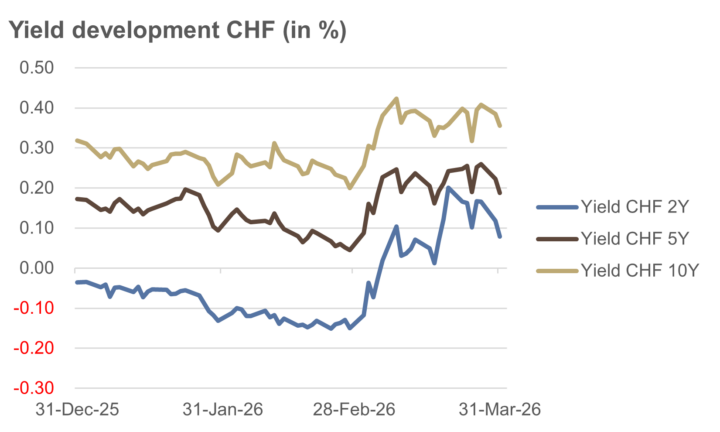
Source: own illustration
Credit
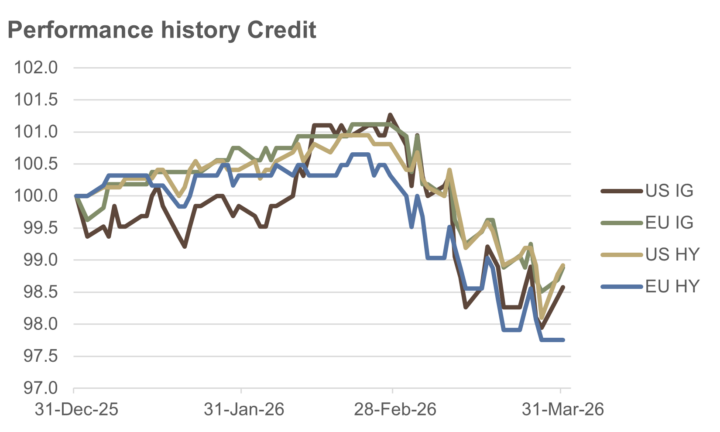
A similar bifurcation was evident across major credit markets. Until the end of February, prices posted modest gains, supported by historically tight credit spreads and declining base rates (government bond yields). However, this backdrop reversed with the outbreak of the Iran war, as rising yields led to corresponding price declines.
Notably, credit spreads in the high-yield segment had already reached their trough at the end of January and began to show early signs of widening in February, before this trend accelerated markedly in March. By quarter-end, spreads stood at 328 basis points in the US (281 basis points at end-2025; +47 basis points) and 337 basis points in Europe (270 basis points at end-2025; +67 basis points).
As a result, high-yield markets delivered negative performance over the quarter. Euro high-yield bonds declined by 2.3%, while US high-yield bonds fell by 1.1%. Investment-grade bonds also posted losses: in Europe, returns were down 1.1%, while US investment-grade bonds declined by 1.4%, reflecting rising Treasury yields and somewhat longer duration.
Emerging market sovereign bonds in US dollars fell by 2.5% in the first quarter, weighed down by geopolitical risks and a stronger US dollar.
By contrast, global convertible bonds proved a bright spot, delivering gains of 3.0%. They benefited both from the positive equity market performance at the start of the quarter and from the increase in volatility in March, which raised the value of embedded options.
Source: own illustration
Equities
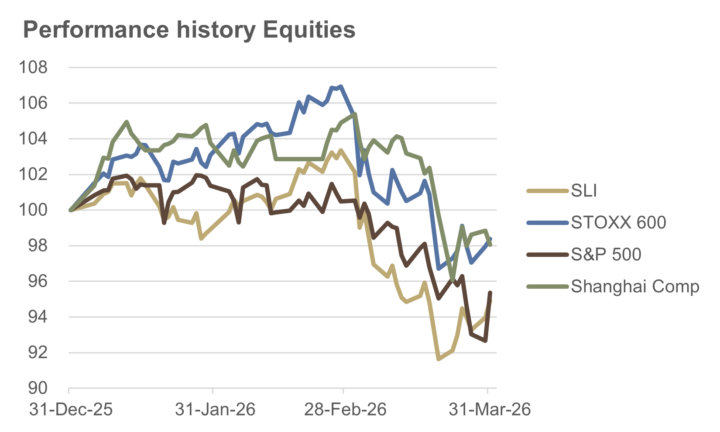
The first quarter of 2026 in equity markets was characterised by a pronounced rotation away from highly valued growth stocks towards value and resource-oriented markets. In this context, Goldman Sachs coined the acronym HALO (“Heavy Assets, Low Obsolescence”). The outbreak of the Iran war in late February also marked a clear inflection point in market performance.
In the United States, the benchmark S&P 500 reached a new all-time high of 6,979 on 27 January, but ended the quarter down 4.6%. Losses were more pronounced in the technology-heavy Nasdaq Composite, which declined by 7.1%, and among the largest stocks (as measured by the XLG ETF), which fell by 8.0%. By contrast, the equal-weighted S&P 500 – measured by the RSP ETF – managed to post a modest gain of 0.2%.
In Europe, the picture was relatively more resilient. The STOXX 600 declined by 1.6%, outperforming US markets. The Swiss Leader Index, however, disappointed with a decline of 5.1%, weighed down in particular by losses in Richemont, UBS and Holcim. The UK’s FTSE 100 was among the stronger performers, rising by 2.5%, supported by its heavy weighting in energy and mining stocks.
In Asia, performance was mixed. The Shanghai Composite fell by 1.9%, while the Hang Seng in Hong Kong declined by 3.3%. In contrast, Japan’s Nikkei 225 rose by 1.4%.
Among the best-performing markets in the first quarter were South Korea (KOSPI: nearly +20%), Brazil (Bovespa: +16%) and Thailand (SET: +15%). On the downside, Indonesia fell by 18%, while India and Pakistan each declined by 15%, and Vietnam by 10%.
Source: own illustration
Commodities and Alternative Investments
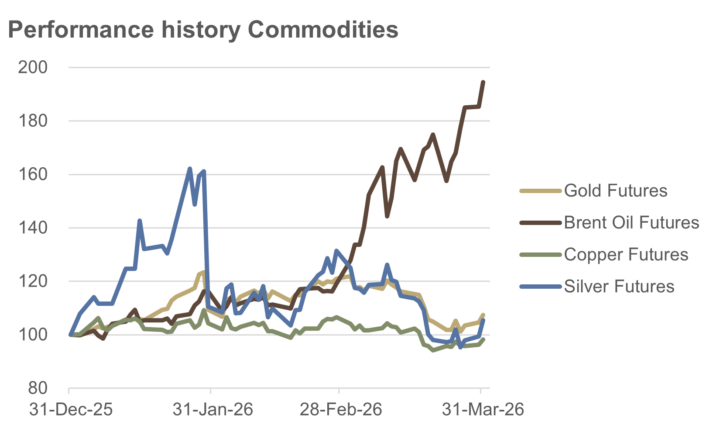
The sharp rise in energy prices was the dominant theme of the first quarter. The outbreak of the Iran war in late February triggered a surge in Brent crude prices of more than 94%, from $61 to $118 per barrel.
Precious metals initially extended their rally at the start of the year, but came under pressure as the quarter progressed. By the end of March, however, gold still posted a gain of 7.4%, while silver rose by 5.5%.
The modest decline in copper prices of 1.7% pointed to growing concerns about a global economic slowdown, particularly against the backdrop of continued weakness in China’s property sector.
Meanwhile, the narrative of Bitcoin as “digital gold” came under increasing strain. Its high correlation with technology equities and pronounced sensitivity to interest rates weighed clearly in the risk-off environment. By quarter-end, Bitcoin had fallen by 22% and Ethereum by 29% against the US dollar.
Source: own illustration
Currencies
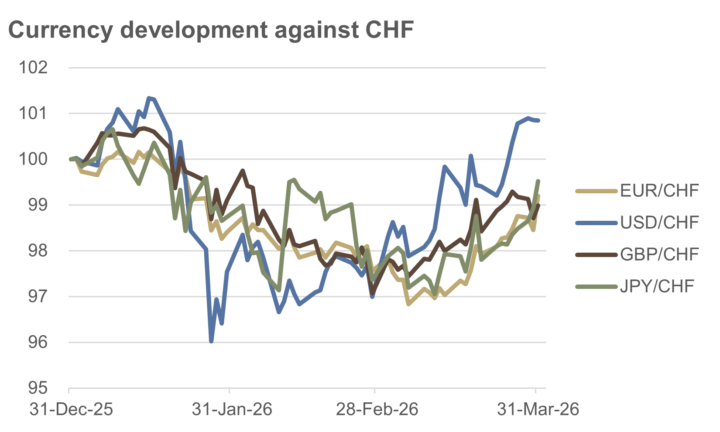
The first quarter of 2026 in foreign exchange markets was marked by unusually dynamic developments. Contrary to the textbook pattern, the Swiss franc was unable to fulfil its role as a “safe haven” during the panic-driven sell-off in March and depreciated against most major currencies.
Over the full quarter, however, the euro declined by 0.8%, sterling by 1.0% and the Japanese yen by 0.5% against the franc. The US dollar, by contrast, edged higher, rising by 0.8% from 0.793 to 0.799. Overall, the dollar index (DXY) benefited from a flight into the world’s reserve currency and gained 1.6%.
The Brazilian real (BRL) stood out as a notable outperformer in the first quarter. By quarter-end, the CHF/BRL exchange rate stood at 6.48, compared with 6.91 at the end of 2025, implying an appreciation of the real of 6.6% against the franc.
Taken together, March 2026 proved to be a month in which safety was sought less in the Swiss franc and more in the US dollar, as well as in commodity-linked currencies such as the Brazilian real. The franc, by contrast, came under modest selling pressure – an atypical development in a risk-off environment.
Source: own illustration
Outlook
“One Battle After Another” – the title of this year’s Oscar-winning film aptly captures the current global backdrop. The Iran war and the escalation in the Middle East mark the beginning of a new phase of global instability. With the effective blockade of the Strait of Hormuz, Iran has brought shipping through this critical waterway close to a standstill. Oil and gas transports have been particularly affected, leading to a marked increase in energy and fertiliser prices.
The probability of a US recession before 2027 rose noticeably over the course of March and is currently estimated at 34% by the forecasting platform Kalshi (as of 5 April 2026). At the same time, growth has slowed significantly: the Atlanta Fed’s GDPNow model estimates US growth for the first quarter of 2026 at 1.6% (as of 2 April 2026), down from expectations of above 3% at the end of February. Growth for the fourth quarter of 2025 has also been revised sharply lower, to +0.7% from +2.7%.
US inflation remained at 2.4% in January and February. However, according to the Cleveland Fed’s nowcasting model, it is expected to rise to 3.25% in March and 3.38% in April (as of 3 April 2026), moving further away from the 2% target, which has not been reached since February 2021.
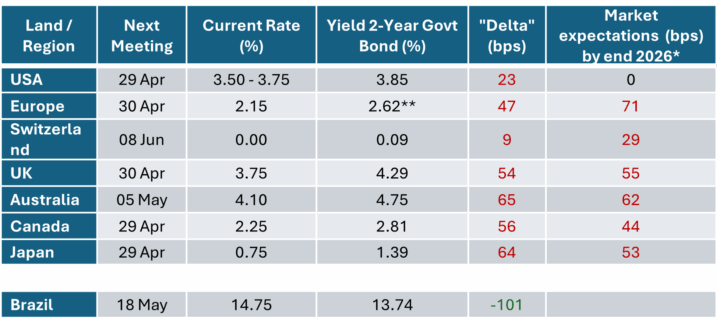
As a consequence, markets have fully priced out the rate cuts previously expected for 2026. Based on two-year US Treasury yields, current market pricing instead implies a somewhat more restrictive monetary policy stance. The table below illustrates this more hawkish repricing of key policy rates, with the “delta” defined as the difference between two-year government bond yields and the respective current policy rate.
Source: own illustration; as of 5 April 2026
*As of 2 April 2026
**Germany
In a stagflationary environment – characterised by higher inflation alongside weaker growth – the risk of monetary policy errors increases. The Federal Reserve is likely to come under new leadership from May. Historically, new Fed chairs have tended to be “tested” by markets relatively quickly, a pattern that is likely to recur in the current, politically charged environment. This is compounded by the fact that we are in the second year of the US presidential cycle, which has historically been particularly challenging.
Fixed Income
Long-term government bond yields are primarily driven by growth and inflation expectations. In the initial weeks following the outbreak of the Iran war, the inflation narrative dominated, fuelled by the oil price rally. Around 20 March, however, a clear inflection point emerged: concerns about inflationary overheating gave way to fears of pronounced demand destruction. Accordingly, oil prices for forward delivery began to decline significantly.
Against this backdrop – defined by the tension between stagflation and a looming recession – we do not assess positions in isolation, but rather in terms of their contribution to overall portfolio stability. The higher level of yields is being used to selectively extend duration, thereby positioning the portfolio for a potential slowdown in growth.
We continue to hold a small allocation to inflation-linked bonds to provide protection against near-term price shocks.
Credit
In credit markets, we maintain a defensive stance and favour investment-grade bonds over high yield. Despite the recent widening, credit spreads remain, in historical terms, at comparatively low levels.
For targeted yield enhancement, Brazilian government bonds appear worth considering. The high real yield buffer can act as an effective return driver without significant compromises in liquidity.
Equities
Historically, stagflationary phases have tended to favour sectors such as utilities, technology, consumer staples and energy, while financials, industrials, consumer discretionary, communication services and small caps have generally come under pressure.
We remain cautiously optimistic, recognising that equities primarily serve as a vehicle for long-term capital preservation and need not deliver positive contributions alongside other asset classes in every market phase. Positioning in futures markets is currently rather bearish, suggesting an absence of euphoria – a potential contrarian indicator. Accordingly, we would consider using further market setbacks selectively to increase equity exposure.
From a regional perspective, the United States currently appears somewhat more attractive than Europe. Europe’s geographical proximity to conflict zones in Ukraine and the Middle East, as well as its dependence on energy imports, is likely to weigh more heavily on the region than on the US economy.
Commodities and Alternative Investments
Despite seasonal headwinds, we maintain a strategic allocation to gold. The price correction in March – following all-time highs above $5,000 per ounce – was likely driven primarily by increased liquidity needs amid heightened volatility. Historically, such effects have weighed on gold prices for around six weeks following a crisis event.
The reversal in US rate expectations also acted as a headwind: while multiple rate cuts had been anticipated only weeks ago, these have now been fully priced out. At present, gold prices do not appear to reflect a pronounced recession risk. Historically, average gains in such phases have been around 15%. At the same time, gold should continue to find support in scenarios of unexpectedly high inflation, as well as in the context of monetary and fiscal experimentation. Profits in silver have been realised.
For oil markets, we expect prices to trend lower in the coming months. Positioning in futures markets is heavily skewed towards further price increases, while many supply shocks appear already priced in. Even modest changes in supply or demand could therefore trigger a reversal. The outlook for copper is less clear-cut: structural demand linked to the energy transition contrasts with cyclical weakness in China.
In agricultural commodities, cocoa prices could surprise to the upside given pronounced bearish positioning, whereas corn, wheat and cotton – where positioning is very bullish – appear more exposed to downside risks.
Currencies
In the second quarter, the euro could surprise to the upside, as current positioning in derivatives markets appears markedly negative. A similar pattern is evident for the Japanese yen and, to a lesser extent, for sterling.
The US dollar, by contrast, appears to be in a mature phase of its appreciation cycle, making a corrective move plausible. This is particularly relevant for the Australian dollar, for which we expect weaker levels in the months ahead.
The Swiss franc is likely to reassert its safe-haven characteristics over the course of the year.
Conclusion
“KISS – keep it simple, stupid” often proves to be the superior strategy in an environment shaped by multiple, and often opposing, forces. In times of crisis, complexity frequently gives rise to correlations that are difficult to control. We therefore focus on liquid and transparent assets, where both the sources of return and the underlying risks are clearly identifiable. The portfolio is consistently viewed as a whole and structured to remain robust across a range of potential scenarios.
Within this framework, government bonds serve as a core defensive building block. In the event of an economic slowdown, longer-duration bonds should benefit, while inflation-linked bonds provide protection in the event of unexpectedly high inflation. In credit, we continue to favour investment-grade over high yield.
In equities, we remain cautiously optimistic and regard the asset class primarily as a tool for long-term capital preservation. Periods of further market weakness would be used selectively to add exposure, particularly in defensive sectors.
We maintain our strategic allocation to gold as a hedge against monetary and fiscal experimentation, as well as geopolitical risks. In addition, we allocate to liquid trend-following CTAs, which, owing to their low correlation with other asset classes, have proven to be effective stabilisers within the portfolio.
On the currency side, we expect the Swiss franc to remain broadly firm. At the same time, we see scope for a positive surprise in the euro in the second quarter, while anticipating weakness in the Australian dollar.