Review
Fixed Income
The yield on 10-year US Treasuries traded within a narrow range of 3.94%–4.21% during the fourth quarter, ending the year at 4.18%, down from 4.57% at the start of the year. The decline was more pronounced at the front end of the curve: the two-year yield closed at 3.47%, compared with 3.60% at end-September and 4.24% at end-December 2024. The “bull steepener” therefore persisted, with the spread between ten- and two-year maturities widening further. Notably, the 30-year Treasury yield was broadly unchanged over the year, remaining above 4.80% at the end of December.
In September, the Federal Reserve delivered its first rate cut of 2025. Two additional cuts followed in late October and December, bringing the target range for the federal funds rate to 3.50%–3.75%. The next Fed meeting is scheduled for 28 January. A rate cut is currently not expected by the vast majority of market participants. Over the remainder of the year, markets are pricing in two further cuts.
In the euro area, ten-year sovereign yields converged during the fourth quarter. The move was most pronounced in Germany, where the yield rose from 2.71% to 2.86%. Elsewhere, changes were modest: Greek yields increased to 3.48% (from 3.41%), Spanish yields to 3.29% (from 3.26%) and French yields to 3.56% (from 3.54%). In Italy, by contrast, the yield edged lower to 3.51% (from 3.56%). The euro area policy rate currently stands at 2.15%. At the ECB’s next scheduled meeting on 5 February, a policy move is considered unlikely; over the course of the year, some market participants even expect rate hikes.
In the UK, the yield on 10-year gilts declined to 4.47% at year-end, from 4.70% at end-September. The Bank of England cut its policy rate to 3.75% during the quarter. The next meeting is set for 5 February. For the remainder of the year, markets are pricing in two to three additional rate cuts.
In Japan, the yield on 10-year JGBs rose to 2.07% (end-September: 1.65%), the highest level since 1999. The Bank of Japan raised its policy rate to 0.75% in December. For 2026, markets expect a further two to three rate increases.
In Switzerland, yields edged higher over the quarter: the 10-year Confederation bond yield rose to 0.32% (from 0.26%), the five-year to 0.17% (from 0.06%), while the two-year yield remained slightly negative at -0.04% (previously -0.11%). The policy rate has stood at 0.00% since June 2025 and has not been changed since. The SNB’s next meeting is scheduled for 19 March. No further policy moves are currently expected over the remainder of the year.
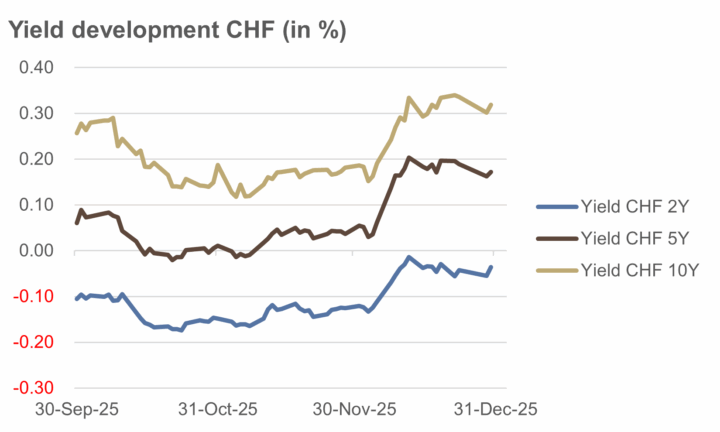
Source: own illustration
Credit
High-yield credit spreads changed little on either side of the Atlantic during the fourth quarter. In the US, spreads stood at 2.81% at year-end, while in Europe they closed at 2.70%. Against this backdrop, overall interest rates in Europe — particularly in Germany — edged higher, whereas longer-dated yields in the US remained broadly stable.
In this environment, prices of US high-yield bonds rose by 1.5% over the quarter, compared with a gain of 1.0% for European high-yield bonds. US investment-grade bonds advanced by 0.8%, while their European counterparts posted a more modest increase of 0.4%.
On a full-year basis, US credit outperformed. Prices of US high-yield bonds rose by 9.5%, while US investment-grade bonds gained 8.0%. In Europe, high-yield bonds advanced by 4.9%, while investment-grade bonds recorded an increase of 3.1% in 2025.
Other credit segments also delivered solid performance in a broadly risk-friendly environment. Global convertible bonds (in US dollars) gained 3.7% over the quarter and rose by 10.5% over the year. Emerging market bonds (also in US dollars) advanced by 2.9% in the fourth quarter, bringing their full-year gain to 12.9%.
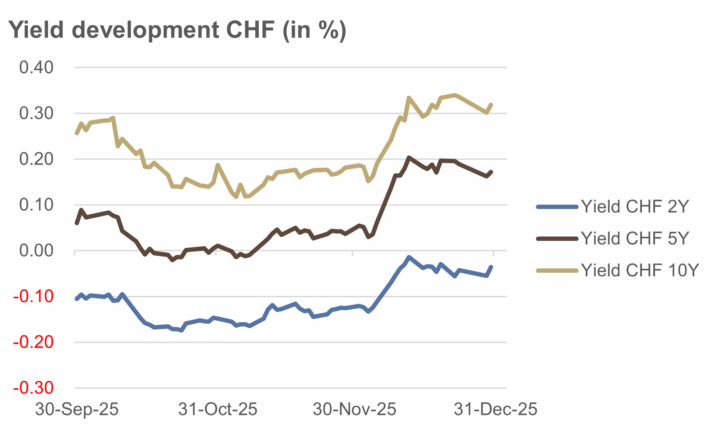
Source: own illustration
Equities
US equity markets remained in a broadly bullish trend during the final quarter of the year, although momentum eased somewhat over the course of November. By year-end, the S&P 500 had gained 2.3%. On Christmas Eve, the benchmark reached its 39th all-time high of 2025, closing at 6,932 points. The technology-heavy Nasdaq Composite rose by 2.6% over the quarter.
An ETF tracking the 50 largest US stocks by market capitalisation (XLG) advanced by 3.3% in the fourth quarter, while an equal-weighted ETF (RSP), in which each of the 500 S&P 500 constituents carries a weight of 0.2%, gained only 1.0%. This divergence underscores the persistently high level of market concentration.
European equity markets significantly outperformed over the quarter. The pan-European STOXX 600 rose by 6.2%, while the Swiss Leader Index (SLI) gained 8.3%. Performance was driven in particular by the two heavyweights Roche and UBS, which delivered above-average returns.
In Asia, the Shanghai Composite rose by 2.2% in the fourth quarter, while Japan’s Nikkei 225 advanced by a robust 12.0%, despite a more restrictive interest rate environment.
On a full-year basis, the S&P 500 gained 16.4%, following increases of 23.3% in 2024 and 24.2% in 2023. The Nasdaq Composite rose by 20.4% in 2025. The XLG ETF was up around 19% for the year, while the RSP ETF gained only 9.3%, further highlighting the dominance of a small number of mega-cap stocks. In Europe, the STOXX 600 recorded a full-year gain of 16.8%, while the SLI rose by 11.8%. In Asia, annual gains amounted to 18.3% for the Shanghai Composite, 27.8% for Hong Kong’s Hang Seng, and 26.2% for the Nikkei 225.
Latin American equity markets also delivered notably strong performance, while markets across several Indochinese countries — including Indonesia, the Philippines, Thailand and Malaysia — lagged behind.
Among the world’s major equity markets, South Korea’s KOSPI stood out with a gain of more than 75% in 2025, by far the strongest performance globally. At the other end of the spectrum, Saudi Arabia’s Tadawul All Share Index ranked last, ending the year down 13%.
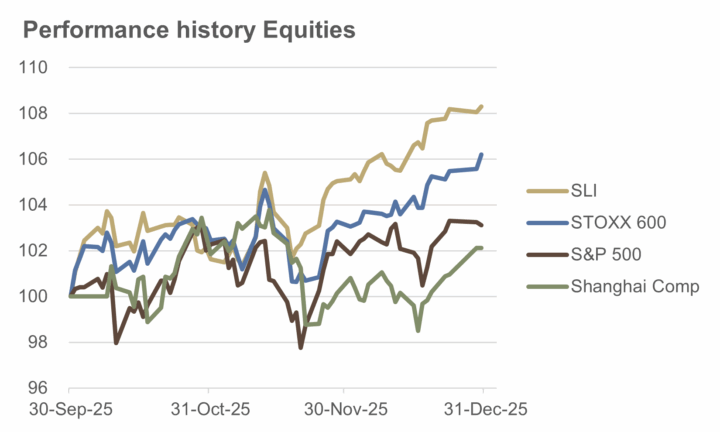
Source: own illustration
Commodities and Alternative Investments
The most striking development was the exceptionally dynamic price action in silver from late November onwards. In the few trading days after Christmas, daily volatility increased sharply, with swings of around 10% in both directions. By the end of the quarter, the grey metal had posted an impressive gain of 52%. Gold, by contrast, moved in a much more orderly fashion, ending the quarter up 12.5%. Copper finished the fourth quarter with a gain of 17.6%.
The price of Brent crude oil declined by 9.2% over the quarter, falling from $67 to just under $61 per barrel. The intraday low was reached in mid-December at $59.
The dominant market narrative of 2025 was the extraordinary surge in silver prices. With an annual gain of 142%, silver recorded its strongest year since 1979. Gold also delivered an outstanding performance, rising by 65% and marking its best annual result since the late 1970s. Copper prices increased by 42% over the year, the largest percentage gain since 2009. By contrast, Brent crude oil fell by more than 18% over the course of the year, declining from $75 to just under $61 per barrel.
The two most important cryptocurrencies both weakened in the fourth quarter. Bitcoin (BTC/USD) fell by 23%, while Ethereum (ETH/USD) dropped by 28%. On a full-year basis, this translated into a decline of 6% for Bitcoin and 11% for Ethereum.
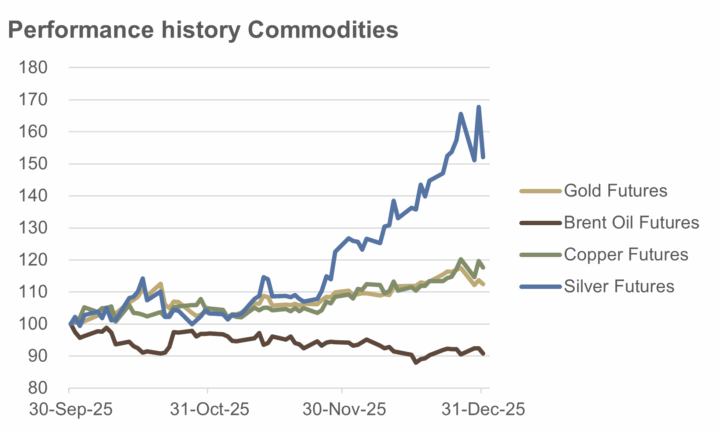
Source: own illustration
Currencies
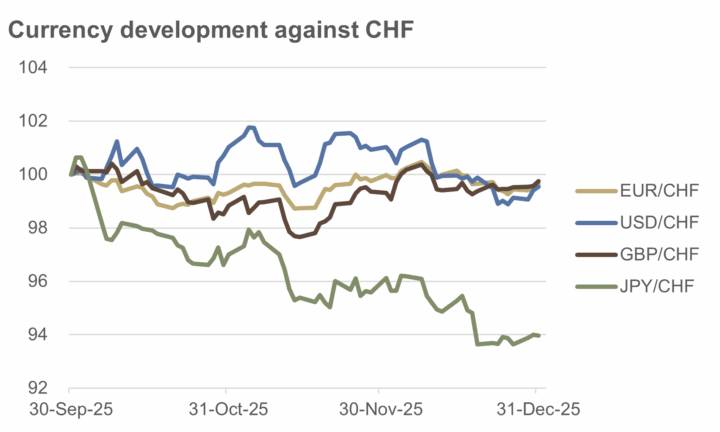
The Swiss franc strengthened modestly against the major trading currencies in the fourth quarter. The euro declined by 0.4% to 0.931, the US dollar fell by 0.5% to 0.793, while sterling slipped by 0.3% to 1.068. The depreciation of the Japanese yen was far more pronounced, with the currency losing 6.0% against the Swiss franc over the quarter.
For the US dollar index (DXY), which measures the greenback against a basket of six major currencies, 2025 proved to be one of the weakest years on record, with a decline of 9.4%.
Over the full year, the US dollar depreciated by 12.6% against the Swiss franc. The EUR/CHF exchange rate was comparatively stable, falling by just 0.9%, while sterling lost 5.9% against the franc. The Japanese yen weakened by 12.3% versus the Swiss currency over the same period.
Within the group of major currencies, the Swedish krona stood out as particularly strong, appreciating by more than 5% against the Swiss franc over the course of the year.
Source: own illustration
It’s Christmas time in the city (…)”
Outlook
The investment year 2025 proved exceptionally successful overall – for equities as well as for corporate and high-yield bonds, and in particular for precious metals. In currency markets, the most striking development was the pronounced weakness of the US dollar against its major trading counterparts. Equally notable was the fact that long-end yields remained broadly stable, despite substantial policy rate cuts by most central banks.
The probability of a US recession before 2027 is currently estimated at 21% by the forecasting platform Kalshi.com (as of 5 January 2026). A recession is commonly defined as two consecutive quarters of negative economic growth.
According to the Atlanta Fed’s GDPNow model, US economic growth in the fourth quarter of 2025 came in at 2.7% (as of 5 January 2026). Growth in the third quarter had surprised on the upside at 4.3% – the strongest reading in two years – following 3.8% in the second quarter and an initial forecast of 3.3%.
Inflation data have also been more benign than expected. In November, headline inflation stood at 2.7%, with core inflation at 2.6%. Based on the Cleveland Fed’s Inflation Nowcasting model, headline inflation is expected to decline to 2.57% in December 2025 and further to 2.27% in January 2026 (as of 5 January 2026). While inflation would thus remain slightly above the 2.0% target, the downward trajectory is clearly intact.
This near-ideal combination of solid growth and easing inflationary pressures provides a supportive backdrop for risk assets such as equities. At the same time, a gradually softening US labour market should give the Federal Reserve additional room to ease policy rates modestly over the course of the year.
Internationally, however, interest rate expectations appear more restrictive. With the exception of the US Federal Reserve and the Bank of England, markets currently see little scope for further rate cuts in 2026.
A note of caution is warranted by the fact that, after three very strong equity market years, bearish voices have largely fallen silent. Most banks and brokers are forecasting further gains in equity markets in 2026 – despite the fact that the second year of the US presidential cycle has historically often been marked by negative surprises.
Nevertheless, we expect a Goldilocks scenario in the US in the first quarter of 2026, characterised by robust growth and further easing inflation. In Europe, by contrast, we anticipate a reflationary environment, with positive economic growth accompanied by slightly rising inflation rates. This backdrop should continue to support risk assets, at least over the medium term.
Fixed Income
Long-term government bond yields are primarily driven by growth and inflation expectations. Slower economic growth or easing inflation typically lead to declining yields and, correspondingly, rising bond prices. While we do not currently expect a pronounced slowdown in either the US or Europe, we do anticipate a further moderation in inflationary pressures in the United States.
Against this backdrop, we favour medium- to long-dated US Treasuries. They also serve as an effective hedge against equity market risk should growth deteriorate unexpectedly. This preference is reinforced by the fact that investor positioning in government bonds remains exceptionally low by historical standards.
To guard against unexpected inflation shocks – which we do not view as a base-case scenario – we maintain a smaller allocation to inflation-linked bonds.
Credit
The macroeconomic backdrop remains broadly supportive for corporate bonds. However, the currently very tight credit spreads in the high-yield segment offer only limited compensation for the risks involved. We therefore favour investment-grade bonds, where the risk-return profile appears more balanced.
A selective allocation to emerging market bonds may enhance returns and diversification and therefore merits consideration.
Equities
For the first quarter of 2026, we remain cautiously optimistic on equities. Admittedly, market pessimists have largely fallen silent — which, from a contrarian perspective, can be read as a warning signal — and valuations, particularly in the US, are no longer cheap. However, positioning in futures markets remains strikingly subdued, suggesting that the market is still far from any state of irrational exuberance.
From a regional perspective, Europe currently appears somewhat more attractive than the US. On both sides of the Atlantic, we favour the materials and energy sector, as well as financials and industrials. By contrast, we remain more restrained in consumer staples.
In addition, we see selective exposure to emerging markets as attractive. Latin America, in particular, could benefit from a renewed emphasis on a “Monroe Doctrine” and from a potential political shift to the right in 2026.
Commodities
The macroeconomic backdrop is likely to remain supportive for precious metals. Rising public debt levels across many countries, together with a broadly more accommodative monetary and fiscal stance, point to sustained structural support. In addition, ongoing geopolitical tensions and political uncertainty should continue to underpin demand for precious metals as stores of value and hedging instruments.
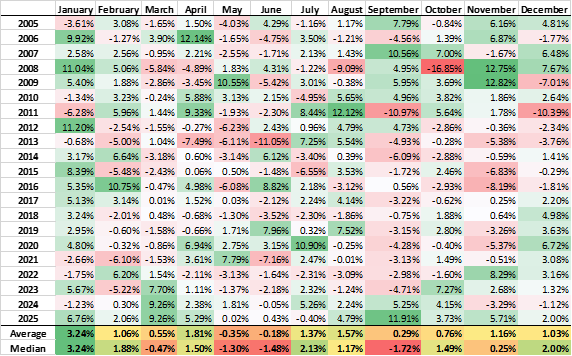
The table below illustrates the monthly price performance of gold (in USD) over the past 20 years.
Source: own illustration; as of 2 January 2026
Seasonality continues to favour precious metals. January and February – and, over the past four years, also March – have historically delivered particularly strong performance for gold. At the same time, positioning in the futures market remains relatively restrained by historical standards, which, from a contrarian perspective, should be seen as a supportive factor. Against this backdrop, we continue to maintain a strategic allocation to gold and, to a lesser extent, to silver.
Copper prices are currently trading at record levels. In the near term, however, we expect a phase of consolidation. The exceptionally bullish positioning in the futures market warrants a degree of caution, even though the longer-term fundamentals remain intact.
By contrast, crude oil prices could surprise to the upside, despite the medium-term trend still pointing lower. Relatively moderate positioning in the futures market argues for an asymmetric risk-reward profile skewed to the upside.
Currencies
We expect the Swiss franc to remain firm in the first quarter of 2026. Alongside the CHF, the Japanese yen and the British pound could also surprise to the upside, not least because positioning in the futures market is currently skewed to the short side.
In an increasingly strained geopolitical environment, the United Kingdom is perceived as a reliable ally of the United States. At the same time, sterling is often viewed as the primary alternative to the US dollar. Should the Bank of England deliver fewer rate cuts than currently priced in by the market, this would provide additional support for the pound. Moreover, the equity sectors we currently favour — materials, energy and financials — are relatively heavily represented in the UK equity market.
The Japanese yen also benefits from extremely negative positioning in the futures market, in addition to its role as a classic safe-haven currency. In an environment of heightened geopolitical uncertainty and further rate hikes by the Bank of Japan, the yen should be well supported. On a purchasing power parity basis, the currency also appears materially undervalued over the longer term.
For the EUR/USD currency pair, we expect the euro to weaken, as the rate hikes by the ECB currently priced in by the market are unlikely to materialise over the course of the year.
Conclusion
At the start of 2026, the market environment remains broadly supportive. In the United States, solid economic growth and easing inflationary pressures continue to underpin risk assets. In Europe, we expect a reflationary backdrop, characterised by moderate growth and slightly rising inflation.
Within this environment, government bonds retain their stabilising role, with US Treasuries in particular providing portfolio ballast. In credit markets, very tight spreads warrant a cautious stance towards high-yield bonds, while investment-grade credit appears relatively more attractive.
In equities, we remain cautiously optimistic for the time being and assign a slight preference to Europe over the United States. On both sides of the Atlantic, we favour companies in the materials, energy, financials and industrial sectors. Precious metals retain their strategic role as a hedge against monetary and geopolitical risks.
On the currency front, the Swiss franc is likely to remain firm, while both sterling and the Japanese yen could deliver positive surprises.