Review
Fixed Income
Yields on 10-year US Treasuries rose by more than 80 basis points (bps; 0.80%) in the third quarter, reaching 5.34% at the end of September, their highest level since 2002 (end-June: 4.42%). The main drivers were geopolitical inflation risks stemming from the war with Iran and the US Federal Reserve’s hawkish turn. On 30 September, the benchmark yield closed slightly lower at 5.29%. Two-year Treasury yields reflected the Fed’s more restrictive stance, rising to 4.89% (end-June: 4.14%) after jumping by 54 bps in September alone. Contrary to initial market expectations, the Fed ended its rate pause at the 16 September FOMC meeting and unanimously raised its policy rate by 25 bps to a target range of 3.75% to 4.00%. The updated projections signalled at least one further rate increase in 2026.
In the eurozone, bond markets also saw a marked rise in yields during the third quarter, overshadowed by political instability in France. German 10-year Bund yields rose to as high as 3.64% during the global sell-off, up from 2.86% at the end of June. At the same time, the spread between French government bonds (OATs) and German Bunds widened significantly, reaching 150 bps at its peak – the highest level since the height of the euro crisis in 2012. The ECB maintained its restrictive monetary policy stance throughout the quarter. The next key monetary policy decision is due at the end of October. Against the backdrop of fiscal tensions across the eurozone, markets were initially expecting policy rates to remain unchanged.
In the UK, the upward trend in yields also continued in the third quarter. Ten-year UK government bond (Gilt) yields ended the quarter at 5.44% (end-June: 4.76%). Despite heightened inflation risks, the Bank of England left its policy rate unchanged at 3.75% at its September meeting, in a closely divided decision.
In Japan, the central bank raised its policy rate by 25 bps to 1.25% in September, the highest level since April 1995. Long-term yields continued their climb as a result: yields on 10-year Japanese government bonds reached a new 30-year high in September and stood at 3.06% at the end of the quarter (end-June: 2.68%).
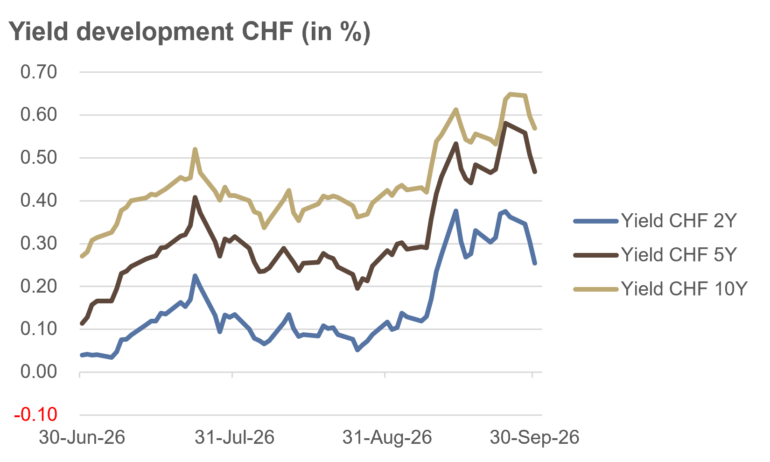
The Swiss National Bank (SNB) remained unfazed by the global shift in interest rates. At its monetary policy assessment on 24 September, it left its policy rate unchanged at 0%, as expected. Nevertheless, the Swiss yield curve could not entirely escape the global trend: yields on 10-year Swiss Confederation bonds rose from 0.27% at the end of June to 0.57% at the end of the quarter. Market expectations also shifted, with some economists already forecasting two moderate rate increases to 0.50% in the first half of 2027.
Source: own illustration
Credit
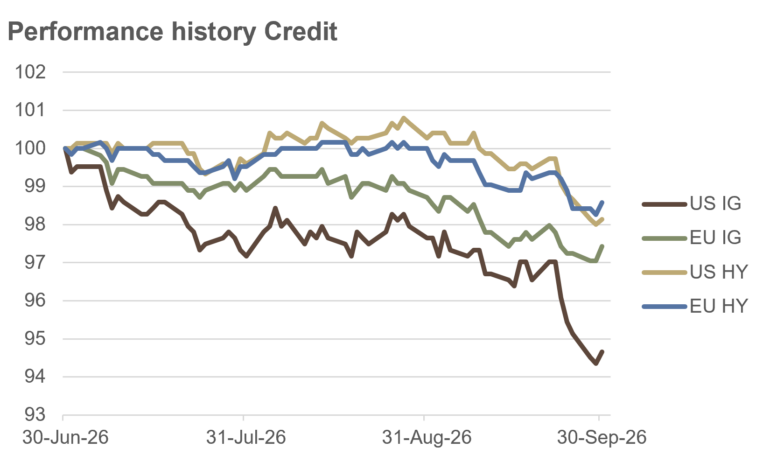
In the third quarter, the positive trend in credit markets reversed noticeably. The sharp rise in government bond yields put corporate bonds under pressure and resulted in broad-based losses. Investment-grade (IG) bonds, with their greater interest-rate sensitivity, underperformed the high-yield (HY) segment by a wide margin. US investment-grade bonds lost 5.3% in the quarter (YTD: -4.7%), while European IG bonds declined by 2.6% (YTD: -1.3%).
High-yield bonds proved more resilient. US high-yield bonds lost 1.9% and were almost unchanged year-to-date at -0.3%. European HY bonds recorded a more moderate quarterly decline of 1.4%, narrowly preserving their positive year-to-date performance of +0.2%.
The performance was therefore in marked contrast to the previous quarter and reflected above all the sharp rise in benchmark government bond yields in September. While higher coupon income partly cushioned the price losses in the high-yield segment, longer-dated investment-grade bonds came under considerably greater pressure from the rise in yields.
Credit spreads also responded to the changed market environment. Following the significant tightening in the first half of the year, spreads widened on both sides of the Atlantic amid higher volatility and geopolitical uncertainty. Investors’ previously strong appetite for risk consequently diminished.
The other segments of the credit market also felt the impact of the sharp rise in yields. Global convertible bonds fell 2.3% in the third quarter, but thanks to their strong first-half performance, still posted a substantial year-to-date gain of 15.6%. US-dollar-denominated emerging-market sovereign bonds came under particular pressure from the stronger US dollar and rising US Treasury yields. They lost 4.5% during the quarter, pushing their year-to-date performance back into negative territory at -2.5%.
Source: own illustration
Equities
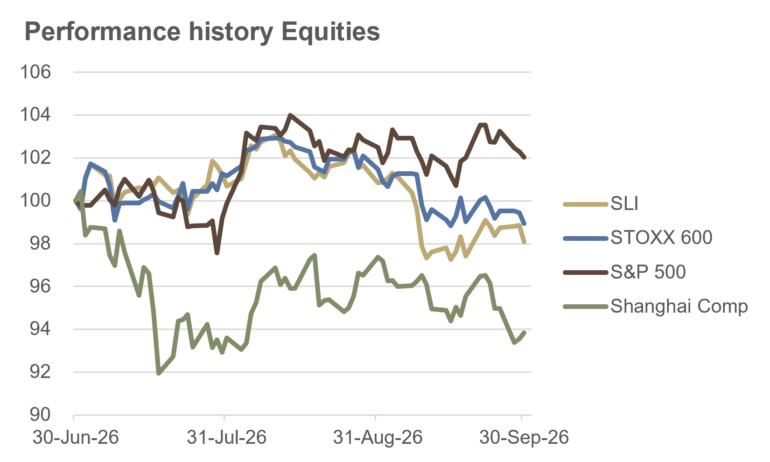
Global equity markets showed markedly greater divergence and the first signs of fatigue in the third quarter. While US indices remained moderately positive, supported by continued strength in the technology sector, markets in Europe and Asia corrected.
In the US, the benchmark S&P 500 gained 2.0% in the quarter, taking its year-to-date performance to 11.8%. The technology-heavy Nasdaq Composite rose 2.5% (YTD: +15.6%). The performance was driven primarily by the largest stocks: the XLG ETF, which tracks the 50 largest US mega-caps, gained 3.9%, while the equal-weighted S&P 500 (RSP ETF) fell 2.2%, signalling a marked deterioration in market breadth.
The performance therefore highlighted the increasing concentration in a small number of winners. While the debate over the monetisation of the substantial investment in AI continued, solid quarterly earnings supported the largest technology companies. The technology heavyweights benefited disproportionately, offsetting part of the losses in the broader market.
European equity markets, by contrast, retreated during the quarter. The pan-European STOXX Europe 600 fell 1.1%, leaving it with a year-to-date gain of 7.1%. The Swiss market declined even more sharply: the Swiss Leader Index (SLI) fell 1.9%, reducing its year-to-date performance to 4.1%. Among Swiss blue chips, only ABB stood out so far this year, with a gain of 38%.
The performance in Asia was marked by profit-taking, in some cases substantial. In China, the Shanghai Composite fell 6.2% in the quarter, pushing its year-to-date performance back into negative territory at -3.2%. In Japan, the Nikkei 225 corrected after its stellar first half, falling 4.7%, although it remained firmly in positive territory for the year at +32.6%.
The most pronounced momentum was seen in South Korea’s KOSPI. Following a doubling in the first half of the year, the index plunged 19.3% in the third quarter. With a year-to-date gain of more than 60%, however, it retained its leading position in global equity markets alongside Taiwan’s Taiex.
Source: own illustration
Commodities and Alternative Investments
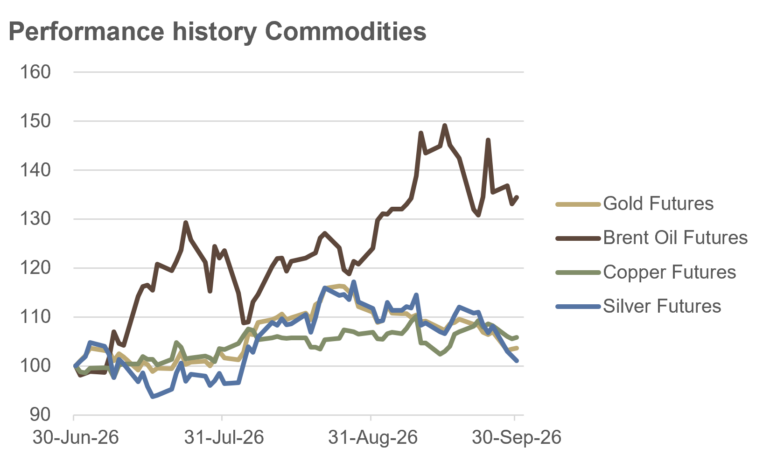
Commodity and crypto markets underwent a trend reversal in the third quarter, driven primarily by geopolitical escalations in the Middle East and a flight into real assets. The price of Brent crude surged by more than 34% during the quarter amid the war with Iran and the continued blockades in the Strait of Hormuz. This took oil’s already strong year-to-date gain to 61%.
The copper price continued its recovery from previous months, rising 5.9% in the third quarter (YTD: +16.0%). Despite the restrictive interest-rate environment, markets thus pointed to unexpectedly robust physical demand for industrial metals outside China’s struggling property sector.
After heavy losses in the spring, precious metals stabilised during the reporting period. Gold benefited from its status as a safe haven in times of crisis as well as from selected central-bank purchases, gaining almost 4% in the third quarter and reducing its year-to-date loss to 3.9%. Silver also moved moderately higher, gaining just over 1%, but remained firmly in negative territory for the year, down 15%.
The cryptocurrencies staged a notable rally in the third quarter, largely recouping their sharp losses in the first half of the year. Bitcoin gained 43% during the reporting period, reducing its year-to-date loss to just 5%. Ethereum performed even more strongly, surging 71% as the market recovered and improving its year-to-date performance to -10% at the end of September.
Source: own illustration
Currencies
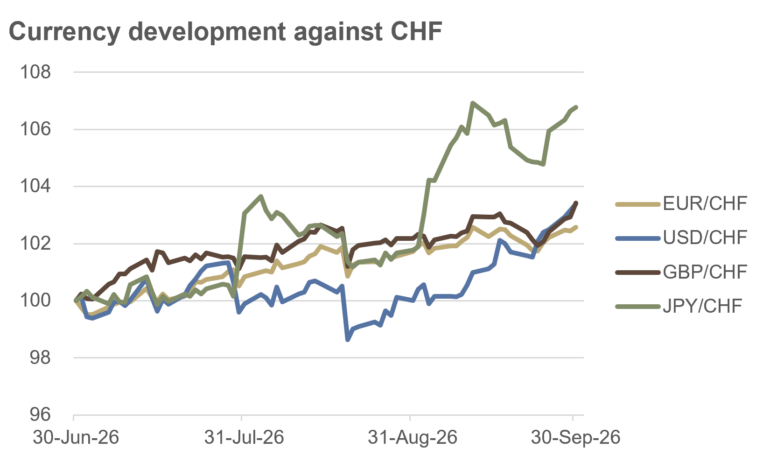
In the foreign-exchange market, existing trends intensified in the third quarter, with the Swiss franc weakening across the board and losing the relative strength it had displayed in the previous quarter. The US dollar continued to appreciate against the Swiss currency: USD/CHF rose by 3.4% over the quarter, taking its year-to-date gain to 5.4%. The euro, which had stagnated in the previous quarter, also gained significantly against the franc: EUR/CHF rose 2.6% in the third quarter and was up 1.7% year to date.
Despite the ongoing monetary-policy debate in the United Kingdom, the British pound also appreciated markedly, rising 3.4% over the quarter and bringing its year-to-date gain against the franc to 3.8%. The Japanese yen staged a notable turnaround after its period of historic weakness in the previous quarter. The yen gained 6.8% in the third quarter, turning its year-to-date performance firmly positive at 4.9%.
The US Dollar Index (DXY), which measures the strength of the US currency against a basket of major global currencies, remained broadly stable, gaining a modest 0.3% in the third quarter. This brought its year-to-date gain to 3.2%. This highlights that the pronounced appreciation of the US dollar against the franc during the quarter primarily reflected specific weakness in the Swiss currency, while the US dollar remained broadly stable at elevated levels within the global foreign-exchange market.
Source: own illustration
Outlook
The high and rising yields on government bonds could increasingly become a serious competitor to equities. In the US, the 10-year inflation-linked, or real, yield recently stood at 2.88%. Based on a forward price/earnings ratio of 20 for the equity market, this implies an earnings yield of 5%. The equity risk premium has therefore fallen to just 2.12% – an extremely low level by historical standards. For this valuation to hold, corporate earnings will need to rise strongly in the years ahead, for example through substantial efficiency gains resulting from artificial intelligence. If this exceptional earnings growth fails to materialise, equity markets would need to correct to restore the risk premium to a healthier level of around 4%.
Markets are therefore facing a battle between sharply rising corporate earnings and rising interest rates.
In the US, corporate earnings have been supported by solid economic growth in recent quarters. Annualised gross domestic product grew by 2.2% in the second quarter, following 2.5% in the first quarter. For the third quarter, the Atlanta Fed GDPNow model estimated growth at 3.7% as of 1 October. According to the prediction platform Kalshi, the probability of a US recession was just under 5% for the current year and 17% for 2027 (as of 4 October 2026). At the same time, inflation remained above the 2% target. Headline inflation stood at 3.4% in August, while core inflation was 2.4%. According to the Cleveland Fed Inflation Nowcasting, headline inflation is expected to rise slightly further to 3.6% in September and October before falling again towards the end of the year.
In the eurozone, inflation jumped to a three-year high of 3.8% in September. The ongoing conflicts in the Middle East and Eastern Europe triggered another increase in oil and gas prices. Core inflation remained more moderate at 2.5%, although it also edged higher from the previous month. Eurozone GDP growth, on an annualised basis, was 0.4% in the first quarter and 2.4% in the second quarter of 2026. Estimates for the third quarter stood at 0.4%.
Against this macroeconomic backdrop, markets are pricing in further interest-rate increases by the major central banks through year-end and into 2027. At the next meetings, however, only New Zealand and possibly the UK are likely to raise rates, while the other central banks are expected to remain on hold for the time being.
Overall, we expect a reflation scenario in the fourth quarter, with solid growth and somewhat elevated inflation rates. The picture could deteriorate in the first half of 2027, however, with both global growth and inflation potentially slowing, particularly if central banks continue to tighten monetary policy.
Fixed Income
Government bond yields have now reached attractive levels across the maturity spectrum – and bond prices have fallen accordingly. At the same time, large speculators and hedge funds hold substantial short positions. Should economic data weaken or an economic slowdown emerge, this could provide support for bond prices and push yields lower.
We therefore continue to hold a strategic position in government bonds as part of portfolio optimisation and are considering a moderate extension of duration. We expect the yield curve to flatten.
We also maintain a smaller position in inflation-linked bonds as protection against unexpected increases in inflation.
In the eurozone, the ECB’s Transmission Protection Instrument (TPI) is likely to be deployed to support French bonds only once the spread over German government bonds exceeds 200 basis points. The spread most recently stood at 140–150 basis points. Another potential trigger could be contagion to other southern European countries such as Italy or Spain. This has not occurred so far. Any deployment of the TPI would support eurozone bond prices, but would likely weigh on the euro against other currencies, particularly the Swiss franc.
Credit
Some market observers currently refer to a K-shaped credit market. On one side are high-quality technology-sector borrowers, the so-called hyperscalers, which are raising enormous sums in the capital markets to finance AI infrastructure and are relatively insensitive to interest rates. On the other side is the much larger remainder of the credit market, which is likely to come under increasing pressure from higher interest rates.
The weakest corporate borrowers, particularly those in the CCC segment and lower, are especially vulnerable, with spreads in the US already above 12%. Highly leveraged companies could also come under greater pressure from rising financing costs as they increasingly compete with hyperscalers for capital.
We therefore continue to prefer investment-grade bonds over high-yield bonds and remain highly selective when investing in private credit markets.
Equities
With the increasing use of AI agents around the clock, so-called “inertia monopolies” could come under pressure. These refer to excess profits earned by established companies because customers remain with overpriced providers out of convenience or because of switching costs. AI-powered payment and optimisation agents could fundamentally change this behaviour.
In the US alone, around USD 5.4 trillion of household money is held in checking and cash accounts, earning an average of just 0.1%. This is precisely where autonomous agents such as Meta Muse come in. While people have so far been too reluctant to fill out forms to take advantage of higher interest rates, AI agents could in future automatically shift these funds to fintech and neobank platforms currently offering yields of 3.3% to 5.0%.
Against this backdrop, we will reduce our exposure to the financial sector somewhat in the fourth quarter. The expected flattening of the yield curve is likely to put additional pressure on banks in particular. Moreover, a substantial share of questionable and illiquid private-market assets sits on the balance sheets of insurance companies.
We also remain cautious on highly leveraged companies given the K-shaped credit market. Our preferred sectors for now remain technology and energy. Geographically, we have a slight preference for the US over Europe.
Among the BRIC countries, Brazil looks interesting. The emerging election victory of Flavio Bolsonaro should provide sustained support for equities, bonds and the currency.
Commodities and Alternative Investments
Gold remains an important stabilising component of our portfolio construction. Despite short-term setbacks, we expect the gold price to continue rising over the long term against the major currencies. We remain somewhat more cautious on silver, partly because of its significantly higher volatility.
We expect oil and copper prices to trend lower, as economic activity is likely to weaken in the first half of 2027. In addition, positioning in the copper futures market is extremely bullish, which has often proved to be a useful contrarian indicator in the past.
For oil, the passage of time is also likely to work against further price increases.
Currencies
The Swiss franc is likely to perform positively against the euro for the remainder of the year. The dislocations in the French government bond market are likely to prompt the ECB to refrain from further rate increases for the time being. The deployment of the Transmission Protection Instrument, or even the public discussion surrounding it, could put additional pressure on the euro.
The Swiss franc is also likely to appreciate against the US dollar in the fourth quarter. While markets are still pricing in at least three further rate increases by the US Federal Reserve through the end of 2027, we expect no more than one additional increase before the Fed begins cutting rates in 2027.
In addition to the Swiss franc, the Japanese yen is likely to strengthen over the longer term based on purchasing-power-parity. We take a more negative view of the commodity currencies CAD, AUD and NZD. The British pound, by contrast, could surprise to the upside.
Conclusion
Flexibility and disciplined risk management remain more important than rigid market forecasts. So far, the global economy has proved remarkably resilient. Inflation is slightly above the 2% target in most economies, while economic growth, particularly in the US, remains solid.
For the fourth quarter, we expect a reflation scenario characterised by solid economic growth and somewhat elevated inflation rates for the time being. The picture could deteriorate in the first half of 2027, particularly if central banks continue to tighten monetary policy.
Against this backdrop, we are maintaining a strategic position in government bonds and considering a moderate increase in duration. In credit, we prefer investment-grade corporate bonds over high-yield bonds. In equities, we are reducing our allocation to financials, namely banks and insurers, and favour technology and energy. Geographically, we have a slight preference for the US over Europe.
Gold remains a strategic component of portfolio construction. In addition, liquid trend-following funds (CTAs) have proved their value with an exceptionally low correlation to the other asset classes.